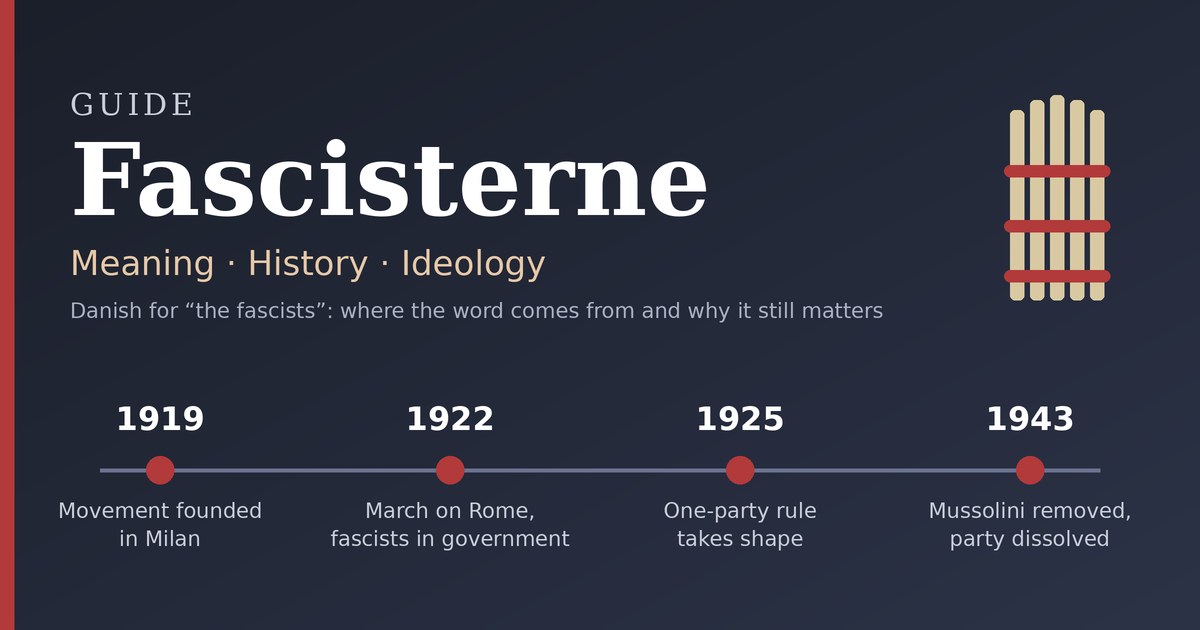
If you have read a Danish history book or a news headline, you have probably met the word fascisterne. It translates simply as “the fascists,” but behind that short word sits one of the most studied and most misused terms in modern politics. This guide explains what fascisterne actually means, where the movement came from, what it believed, and why the word keeps coming up today.
What does “fascisterne” mean?
In Danish, fascist is a person who belongs to or supports fascism, and fascisterne is the group, the movement, or “those people” as a whole. You will see it in textbooks (“fascisterne marcherede mod Rom”), in historical writing, and sometimes in heated online arguments.
The root of the word is Italian. According to Denmark’s national encyclopedia, the word comes from the Italian fascismo, which derives from fascio, meaning a bundle. That in turn goes back to the Latin fasces, the bound rods that symbolized authority in ancient Rome. The image of a bundle fits the idea well: many individuals tied together under one strong power.
Where did fascisterne come from?
The story starts in Italy. Fascism was founded by Benito Mussolini in Milan on 23 March 1919, first as combat groups made up mostly of war veterans. Italy was exhausted after World War I. Unemployment, political violence, and a sense of national humiliation made many people willing to listen to someone promising order and pride.
The key milestones were these:
- 1919: Mussolini founds the first fascist groups.
- 1922: The fascists entered government in October 1922 after the so-called March on Rome.
- 1925 onward: They monopolized power and gradually built an authoritarian regime. One party became the only one allowed.
- 1943: Mussolini was removed by the Fascist Grand Council and the party was dissolved.
Fascisterne did not rise overnight. They gained ground step by step, through street violence, political deals, and promises that sounded simple during a very complicated time.
What did fascisterne believe?
Fascism is better understood as a style of politics and a set of priorities than as a neat checklist. Still, historians point to a few recurring ideas.
The state above the individual. The goal was a strong state, lo stato totale, in which individual and class interests were subordinate to the state as the expression of the nation.
Nation as a living organism. The nation was seen as a body competing with other peoples. War was treated as natural and as the highest expression of the nation.
Rejection of democracy and socialism. Fascisterne described themselves as the alternative to both parliamentary politics and the workers’ movement.
Corporatism. Instead of free unions and open class conflict, society was organized into state-supervised groups.
Cult of the leader. Mussolini was il Duce, “the leader.” Loyalty went to a person as much as to a program.
Propaganda and uniformity. Schools, youth groups, and the press were pulled into the project of building a single national identity.
Fascisterne and Nazism: the same thing?
Not quite, and this is where many articles get sloppy. The Danish encyclopedia notes that German National Socialism emerged almost simultaneously and shared related traits, and most later scholars see the Nazi movement phase as having a similar profile and political style. The regimes, however, differed. The Nazi regime was built on racism and aimed at a racially “pure” German society. lex
Scholars also debate how neatly the label fits. It remains disputed whether the various movements can be gathered under one concept of fascism, since they showed national differences and special features. So when someone says “fascisterne” in a general way, it helps to ask which country, which decade, and which movement they mean.
Fascist movements outside Italy
Even in its own time, “fascism” became a broad label. It was applied to related movements such as the British Union of Fascists, the Croix de feu in France, the Spanish Falange, the Iron Guard in Romania, the Ustaša in Croatia, and the Heimwehr in Austria. In the Nordic region, fascist-inspired movements appeared, but only the Finnish Lapua Movement became significantly important.
That last point is worth remembering for a Danish audience. The fascist idea reached Scandinavia, but it found far less fertile ground than it did in countries with deep economic collapse, humiliation, and weak democratic institutions.
Quick-reference guide: fascisterne at a glance
| Topic | Key facts | Why it matters |
|---|---|---|
| Meaning | Danish for “the fascists”; from Italian fascio (“bundle”) | Explains the symbol and the idea of unity under power |
| Origin | Founded by Mussolini in Milan, 1919 | Shows fascism began as a postwar veteran movement |
| Rise to power | In government from October 1922; one-party control from 1925 | Shows the step-by-step nature of the takeover |
| Core ideology | Total state, nationalism, anti-democracy, anti-socialism, war glorified | Helps identify what separates fascism from ordinary conservatism |
| Economic model | Corporatism, with society organized around the state | Contrasts with both free-market and communist models |
| Relation to Nazism | Related in style, different in regime and racial doctrine | Prevents the two being treated as identical |
| End of the regime | Mussolini removed in 1943; party dissolved | Marks the fall of the original fascist state |
| Modern echoes | Neo-fascist parties formed after 1945, such as the MSI in Italy | Shows how the debate continues today |
| Common mistake | Using “fascisterne” for any strong or disliked government | Dilutes the term and weakens real analysis |
Does fascism still exist today?
After 1945, the story did not simply end. The Movimento Sociale Italiano was created in 1946 and was later continued as Alleanza Nazionale in 1994. More recently, Fratelli d’Italia, formed in 2012 and inspired by neo-fascism, became the largest party in Italy’s September 2022 election; its leader Giorgia Meloni does not call herself a fascist but is an avowed admirer of Mussolini. Whether such parties deserve the label is a live political argument, and historians themselves disagree. lexlex
The practical lesson is to use the word carefully. Calling every opponent “fascisterne” makes the term meaningless, while refusing to ever use it can hide real warning signs. A useful test is to look for the full package: a leader cult, contempt for democratic institutions, the belief that the nation matters more than individual rights, and the use or glorification of political violence.
Warning signs historians look for
Studying how fascisterne gained ground gives us patterns, not predictions. These are the signals most often discussed:
- Deep economic insecurity combined with national resentment.
- Political violence that is tolerated or excused.
- Attacks on free press, courts, and opposition parties.
- A single leader presented as the only solution.
- Scapegoating of a minority group for the nation’s problems.
No single sign proves anything. It is the accumulation that matters.
Learning it first-hand
Reading is a good start, but standing in a museum or at a memorial site makes the history real. Many schools, universities, and history clubs organize study tours to European memorial sites. If you are planning something similar for a group, reliable group transportation makes the logistics far easier, so everyone can focus on learning rather than schedules.
For a rigorous starting point in Danish, the Lex entry on fascisme is written by a university historian and is a trustworthy foundation for further reading.
Frequently asked questions
What does fascisterne mean in English?
It means “the fascists.” The ending -erne is the Danish definite plural.
Who founded fascism?
Benito Mussolini, in Milan in 1919.
Is fascisterne the same as Nazis?
No. They are related, but the Nazi regime was built on racial ideology and the fascist regime in Italy was not, at least at the start. Historians still debate how closely to link them.
Is it correct to call modern politicians fascisterne?
It is contested. Most scholars recommend judging by specific features and actions instead of using the label as a general insult.
Final thoughts
Understanding fascisterne means understanding more than a single word. It means knowing how a postwar crisis turned into a dictatorship, why the idea spread, why it failed in some places, and why historians still argue about its boundaries. Use the term precisely, read from reliable sources, and keep asking the same question good historians ask: what exactly happened, where, and why?