
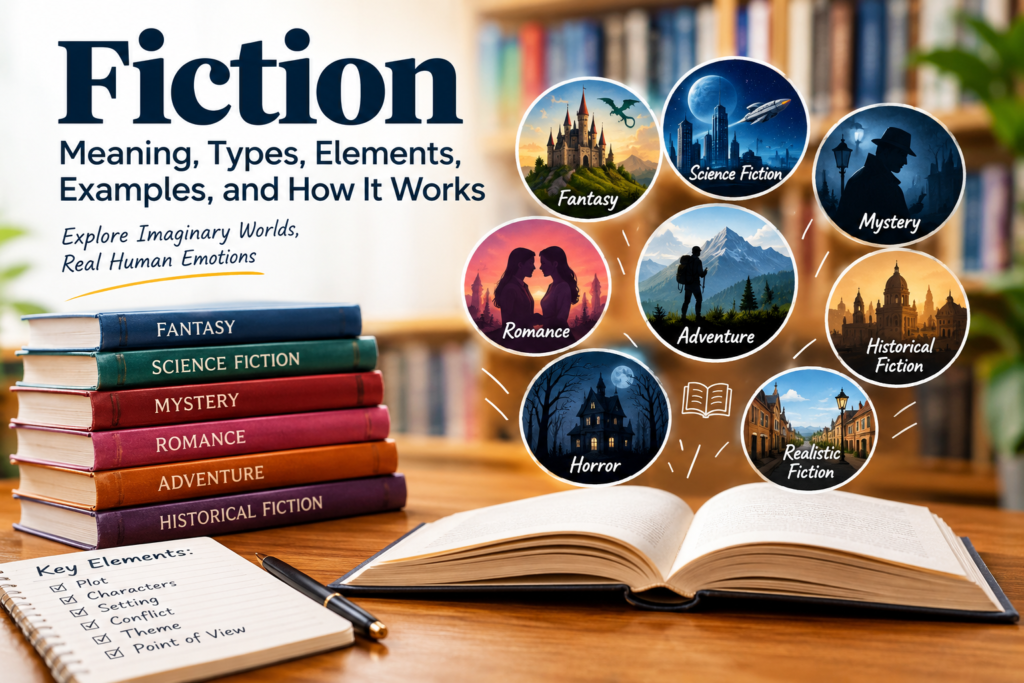
Fiction is one of the most popular forms of storytelling. It allows writers to create imaginary characters, places, events, and situations that entertain readers, explore human emotions, and share ideas about life. Fiction can take the form of a short story, novel, fantasy adventure, mystery, romance, science fiction book, or even a movie script.
Many fictional stories are completely imaginary, while others use real places, historical periods, and everyday experiences as inspiration. A story can describe an ordinary family dealing with a difficult situation or an imaginary planet where humans meet new forms of life. Both can be examples of fiction because the writer creates the story rather than presenting it as a factual account.
Understanding fiction helps readers choose books they enjoy, students analyze literature, and new writers develop their storytelling skills. In this guide, you will learn what fiction means, discover its main types and elements, explore examples, and understand the difference between fiction and nonfiction.
What Is Fiction?
Fiction is a type of writing or storytelling based mainly on imagination. It presents invented characters, events, conversations, or situations rather than claiming to report everything exactly as it happened in real life.
For example, a story about a young girl who discovers a secret door leading to an underground kingdom is fiction. The kingdom and its events are imaginary, even if the story includes familiar places, realistic emotions, and situations that readers recognize.
Fiction appears in many formats, including novels, short stories, plays, films, television shows, comics, and digital storytelling. It can be written for children, teenagers, or adults.
However, fiction does not always mean that every detail is imaginary. Writers often use real historical events, cities, cultures, and personal experiences to make their stories believable. The characters and main events may still be invented.
Fiction can also explore serious subjects, such as friendship, family relationships, poverty, courage, discrimination, and personal growth. Although the events are fictional, the emotions and questions raised by a story can be meaningful in real life.
What Are the Main Types of Fiction?
Fiction includes several genres, each with its own style, themes, and storytelling methods. Readers often choose a genre based on their interests, while writers use genres to help shape their stories.
1. Literary Fiction
Literary fiction often focuses on character development, human relationships, emotions, and social issues. Instead of relying only on action or suspense, these stories may explore why people behave in certain ways and how their experiences change them.
For example, a novel about a family dealing with loss, personal disagreements, and changing relationships may be considered literary fiction.
This type of fiction often encourages readers to think about human behavior and the meaning behind everyday experiences.
2. Science Fiction
Science fiction explores imagined scientific discoveries, advanced technology, space travel, artificial intelligence, time travel, or future societies.
A science fiction story might follow astronauts who discover life on another planet or a scientist who develops a machine that allows people to communicate across time.
Although these stories are imaginary, writers often use real scientific ideas to make their fictional worlds more convincing. Science fiction can also raise questions about how technology might affect society.
3. Fantasy Fiction
Fantasy fiction includes magical events, supernatural powers, imaginary creatures, and worlds that do not follow the ordinary rules of reality.
Common examples include stories about dragons, wizards, enchanted forests, magical objects, and fictional kingdoms.
Fantasy writers create their own rules for magic and supernatural events. A successful fantasy story usually gives readers enough information to understand how its imaginary world works.
4. Mystery Fiction
Mystery fiction centers on a puzzle, unexplained event, crime, or secret that characters attempt to solve.
The main character may be a detective, journalist, investigator, or ordinary person who becomes involved in an unusual situation.
Mystery stories often include clues, suspects, misleading information, and unexpected discoveries. The writer gradually reveals information so readers can try to solve the mystery before the ending.
5. Thriller and Suspense Fiction
Thriller fiction focuses on danger, tension, and urgent situations. The main character may need to escape a threat, prevent a crime, uncover a conspiracy, or protect someone from harm.
Suspense develops when readers know that something important may happen but do not know exactly when or how it will occur.
These stories often use short scenes, difficult decisions, unexpected events, and time pressure to keep readers interested.
6. Romance Fiction
Romance fiction focuses on romantic relationships and the challenges people face while building or maintaining them.
Characters may experience misunderstandings, family pressure, personal differences, emotional struggles, or obstacles that affect their relationship.
Many romance stories conclude with the main couple finding happiness together or reaching a satisfying resolution to their relationship.
7. Historical Fiction
Historical fiction uses a real historical period as the setting for an invented or partly invented story.
For example, a novel might follow a fictional family living during a major historical event. The family members may be imaginary, but the writer can use real clothing, customs, buildings, and historical conditions to create an authentic setting.
Writers of historical fiction should research the period carefully and distinguish invented events from historical facts when explaining the work to readers.
8. Horror Fiction
Horror fiction aims to create fear, discomfort, uncertainty, or a sense of danger.
Its stories may involve ghosts, monsters, haunted houses, psychological fears, or ordinary people facing disturbing situations.
Horror does not always depend on supernatural creatures. A realistic story about isolation, fear, or an unknown threat can also create a frightening experience.
9. Adventure Fiction
Adventure fiction follows characters through exciting challenges, journeys, discoveries, and dangerous situations.
The story may involve searching for hidden treasure, exploring an unknown island, surviving in the wilderness, or rescuing someone from danger.
Adventure stories often emphasize courage, problem-solving, teamwork, and personal growth.
What Are the Main Elements of Fiction?
Most fictional stories use several key elements to create a clear and engaging narrative. The way these elements work together affects how readers understand the characters, follow the events, and interpret the story’s meaning.
1. Plot
The plot is the sequence of events that makes up a story. It explains what happens and how one event leads to another.
A traditional plot often includes five stages:
- Exposition: Introduces the main characters and setting.
- Rising action: Develops the main problem and increases tension.
- Climax: Presents a major turning point or the most intense moment.
- Falling action: Shows the consequences of the turning point.
- Resolution: Brings the main conflict to a conclusion or leaves readers with a meaningful ending.
Not every story follows this structure exactly. Some begin in the middle of an event, move between different timelines, or leave important questions unanswered.
2. Characters
Characters are the people, animals, or imaginary beings involved in a story. Their actions, decisions, and relationships move the plot forward.
The main character is often called the protagonist. The character or force opposing the protagonist is commonly called the antagonist.
Characters can also be described in other ways:
- Main characters: Play a central role in the story.
- Supporting characters: Help develop the plot or influence the main characters.
- Dynamic characters: Change significantly during the story.
- Static characters: Remain largely the same throughout the story.
Believable characters have goals, strengths, weaknesses, and reasons for making decisions. Their behavior helps readers understand the story and care about what happens next.
3. Setting
Setting describes where and when a story takes place. It can include a city, village, school, forest, imaginary planet, historical period, or future society.
The setting may also include weather, culture, social conditions, and the atmosphere surrounding the characters.
A story set in a crowded city can feel very different from one set in an isolated village. Writers can use real locations, such as New York’s Times Square, as inspiration for scenes involving crowds, bright lights, busy streets, and urban life.
A well-developed setting helps readers picture events and understand how the environment influences the characters.
4. Conflict
Conflict is the central problem or struggle that drives a story. Without a meaningful challenge, a fictional narrative may feel flat or lack direction.
Common types of conflict include:
- Character vs. character: Two people have opposing goals.
- Character vs. self: A character struggles with fear, guilt, doubt, or a difficult decision.
- Character vs. society: A person challenges social rules or unfair systems.
- Character vs. nature: A character tries to survive a storm, flood, or wilderness.
- Character vs. technology: A person faces problems caused by a machine or technological system.
A story can include more than one type of conflict. These struggles create opportunities for characters to make difficult decisions and change over time.
5. Theme
The theme is the central idea or deeper message explored in a fictional work.
Common themes include friendship, love, courage, family, justice, betrayal, identity, and the consequences of greed.
For example, a story about a person who loses everything because of dishonesty may explore the importance of honesty and responsibility.
A theme is different from a plot. The plot explains what happens, while the theme explores what the events may suggest about life or human behavior.
6. Point of View
Point of view describes the perspective from which the story is told.
The most common forms include:
- First person: The narrator uses words such as “I” and “we” to tell the story.
- Second person: The narration addresses the reader as “you.”
- Third-person limited: The narrator follows the thoughts and experiences of one main character or a restricted group of characters.
- Third-person omniscient: The narrator can describe the thoughts, feelings, and experiences of multiple characters.
The chosen point of view affects how much readers know about the characters and events. First-person narration can create a personal connection, while third-person narration gives writers more flexibility when describing different parts of a story.
7. Dialogue and Style
Dialogue is the conversation between characters. It can reveal personality, communicate information, develop relationships, and create tension.
Writing style includes the writer’s word choices, sentence structure, tone, descriptions, and use of literary techniques.
Some writers use simple language and short sentences, while others prefer detailed descriptions and complex sentence structures. The most effective style depends on the intended audience, genre, and purpose of the story.
Fiction vs. Nonfiction: What Is the Difference?
Fiction and nonfiction are two broad categories of writing. The main difference is the way each presents its content.
Fiction primarily uses invented characters and events. Nonfiction aims to communicate facts, real experiences, or information about the actual world.
| Feature | Fiction | Nonfiction |
|---|---|---|
| Main purpose | Tell an imagined story or explore ideas through storytelling | Present facts, information, or real experiences |
| Characters | Often invented | Usually real people when individuals are discussed |
| Events | May be imagined or adapted | Based on real events or evidence |
| Structure | Built around a narrative, conflict, or story | Organized by topic, argument, chronology, or real events |
| Common examples | Novels, fantasy stories, mysteries | Biographies, textbooks, news reports |
| Use of imagination | Central to the storytelling | May be used for presentation, but factual claims should remain accurate |
There can be some overlap between the two categories. Historical fiction, for example, may combine real historical figures with invented characters. Creative nonfiction uses storytelling techniques while remaining grounded in real events.
The important point is that readers should be able to recognize whether a work presents itself as an imagined story or a factual account.
What Are Some Examples of Fiction?
Fiction appears in books, movies, television programs, plays, comics, and online stories. These examples show how different genres use imagination to communicate ideas.
Example 1: A fantasy story
A young student discovers a hidden library where books contain spells. When a dangerous spell escapes from one of the books, the student must find a way to protect the town.
This is fantasy fiction because it includes magical events and an imagined situation.
Example 2: A mystery story
A valuable painting disappears from a small museum. A young investigator questions the staff, studies the security footage, and discovers that the person who appears most suspicious is actually innocent.
This is mystery fiction because the plot revolves around a secret and its solution.
Example 3: A realistic fictional story
A teenager moves to a new city, struggles to make friends, and learns to manage school responsibilities while helping a family member.
This is realistic fiction because the characters and events could occur in ordinary life, even though the specific story is invented.
Example 4: Science fiction
Scientists discover a planet that may support human life. A research team travels there but encounters an unexpected problem with its communication equipment.
This is science fiction because it uses an imagined space mission and a speculative scientific situation.
These examples also show that fiction does not need magic, monsters, or extraordinary events. Ordinary human experiences can provide the foundation for a compelling fictional story.
Why Is Fiction Important?
Fiction provides entertainment, but its value extends beyond helping people pass the time. It can encourage readers to think about experiences that differ from their own and consider how other people might feel or respond in difficult situations.
Fiction develops imagination
Reading fictional stories allows people to picture unfamiliar places, characters, and possibilities. Fantasy and science fiction, in particular, encourage readers to consider ideas beyond their everyday surroundings.
Fiction can support empathy
Stories often present situations from a character’s perspective. Readers may gain a better appreciation of different emotions, relationships, and life circumstances by following a character’s experiences.
Fiction improves language skills
Reading fiction exposes readers to vocabulary, dialogue, sentence patterns, and different writing styles. Students and language learners can use stories to improve reading comprehension and learn how language works in context.
Fiction explores social issues
Writers can use imaginary characters and situations to discuss real concerns, such as inequality, family pressure, discrimination, poverty, or the misuse of power.
A fictional story may present these issues through personal experiences, allowing readers to consider their causes and consequences.
Fiction provides relaxation and entertainment
Many readers turn to fiction because they enjoy following a story. A mystery offers a puzzle, a romance explores relationships, and an adventure provides excitement. Choosing a genre that matches personal interests can make reading a more enjoyable habit.
How to Write a Fiction Story
Writing fiction does not require an elaborate idea or a complicated writing process. Beginners can start with a simple character, a problem, and a clear outcome.
Step 1: Choose a story idea
Start with a situation that interests you. It could involve a family secret, an unexpected discovery, a difficult decision, or a journey into an unfamiliar place.
A useful starting question is: What would happen if something unusual occurred in an ordinary person’s life?
Step 2: Create believable characters
Decide who the main character is, what they want, and what prevents them from achieving their goal.
Give the character strengths and weaknesses. A character who makes mistakes and learns from them often feels more realistic than one who succeeds at everything.
Step 3: Choose the setting
Decide where and when the story takes place. Think about how the location, time period, and surroundings affect the characters and events.
You can use a real location or create an imaginary one, as long as the setting supports the story.
Step 4: Develop the conflict
Give the main character a problem that requires action. The problem should matter to the character and create a reason for readers to keep reading.
The conflict might involve an external challenge, an internal struggle, or both.
Step 5: Plan the beginning, middle, and end
Introduce the situation, develop the problem, and decide how the character will respond. You do not need to plan every detail, but knowing the main turning point and likely ending can help keep the story focused.
Step 6: Write natural dialogue
Characters should speak in ways that suit their personalities, ages, backgrounds, and circumstances. Dialogue should help the story move forward rather than repeat information readers already know.
Step 7: Revise the story
After writing the first draft, review the plot, characters, grammar, pacing, and ending. Remove repeated information, correct unclear sentences, and make sure each important event has a purpose.
Reading the story aloud can help you identify awkward dialogue and sentences that do not flow naturally.
Common Mistakes to Avoid When Writing Fiction
New writers often focus heavily on the idea but overlook the details that make a story enjoyable.
Here are some common mistakes to avoid:
- Weak characters: Give characters clear goals, motivations, and believable reactions.
- Unclear conflict: Make the main problem understandable early in the story.
- Too much description: Describe important details without slowing every scene.
- Unnatural dialogue: Make conversations sound appropriate for the characters and situation.
- Inconsistent story rules: If your fictional world has special rules, apply them consistently.
- A rushed ending: Allow important conflicts to develop before resolving them.
- Unnecessary repetition: Each scene should add information, develop a character, or move the plot forward.
Writers do not need to follow a rigid formula. Experimenting with structure, tone, and narrative style can produce interesting results, provided the choices serve the story.
FAQ’s
What does fiction mean in simple words?
Fiction means an imagined story created by a writer. It may include invented characters, places, conversations, and events, even when it draws inspiration from real life.
What are the main types of fiction?
Common types include literary fiction, science fiction, fantasy, mystery, thriller, romance, historical fiction, horror, and adventure. Each genre uses different themes and storytelling methods.
What are the five main elements of fiction?
Five commonly taught elements are plot, character, setting, conflict, and theme. Point of view, dialogue, and writing style are also important parts of fiction.
Is fiction real or imaginary?
Fiction is primarily imaginary, although it may include real people, places, historical events, and experiences. The central story is presented as an invented narrative rather than a fully factual account.
What is the difference between fiction and nonfiction?
Fiction mainly presents invented stories, while nonfiction aims to present real events, facts, experiences, or information. A novel is generally fiction, whereas a biography is nonfiction.
Can a true story be fiction?
A story based on real experiences can become fiction when the writer invents or substantially changes characters, events, or other details. If a work claims to report actual events accurately, it should distinguish verified facts from invented material.
Why do people read fiction?
People read fiction for entertainment, relaxation, imagination, language development, and insight into human behavior. Different genres offer different experiences, from solving mysteries to exploring relationships or imaginary worlds.
Is a novel always fiction?
No. Many novels are fictional, but the word “novel” describes a long-form work of prose rather than automatically confirming that its content is invented. Some long-form books present real events and are classified as nonfiction.
Conclusion
Fiction is a broad form of storytelling that allows writers to create imagined experiences while exploring ideas that matter to real people. Its many genres include fantasy, science fiction, mystery, romance, horror, historical fiction, and realistic stories.
The main elements of fiction—plot, characters, setting, conflict, theme, and point of view—work together to create a meaningful narrative. Understanding these elements helps readers analyze stories and gives new writers a practical foundation for creating their own work.
Whether you enjoy a short story, a mystery novel, a fantasy adventure, or a realistic drama, fiction offers many ways to explore imagination, relationships, and human experiences. The best place to start is with a story that interests you, whether you want to read one or write it yourself.