Lightweighting is central to achieving sustainability and fuel efficiency in aviation.
Even small components, such as fasteners, play a significant role in reducing the total aircraft weight.
Material innovation (titanium, composites, polymers) enables strength without added mass.
Advanced manufacturing methods, such as 3D printing and CNC machining, improve precision and reduce waste.
Collaboration among manufacturers, engineers, and regulators ensures safety and compliance with certification standards.
Introduction to Lightweighting in Aviation
Lightweighting has become a defining strategy in aviation’s ongoing journey toward heightened fuel efficiency and sustainability. Airlines and manufacturers are increasingly focused on this approach, exploring new materials and technologies that help minimize aircraft weight without compromising safety or performance. While attention often focuses on large structural components, a subtle but essential part of this transformation involves fasteners—the tiny connectors and joiners that hold aircraft structures together. The selection of fasteners and their materials is a critical factor for manufacturers and hardware distributors seeking to offer the next generation of aircraft components.
With modern commercial aircraft comprising millions of fasteners, the weight and durability of these elements significantly impact overall efficiency. Recent advancements in design and material science ensure that even these small parts play a pivotal role in reducing fuel consumption for both passenger and cargo fleets. Reimagining fasteners means more than just lighter planes—it means tangible cost savings, regulatory compliance, and smaller environmental footprints.
The Impact of Weight Reduction on Fuel Efficiency
There is a clear and calculable connection between the weight of an aircraft and its fuel economy. According to a study by the U.S. Department of Energy, reducing just 10% of an aircraft’s mass translates to a 6-8% improvement in fuel efficiency. With escalating fuel costs and mounting pressure to cut carbon emissions, airlines and OEMs are under constant incentive to seek out every opportunity for weight reduction, from large wing panels down to the smallest bolt.
A kilogram saved at takeoff accumulates into thousands of gallons of fuel saved each year per aircraft, as reported by airlines such as Southwest and easyJet. For a global fleet, the commercial and environmental impacts are substantial, prompting companies to adopt lightweighting as a crucial pillar of their operational strategy.
Innovations in Fastener Materials
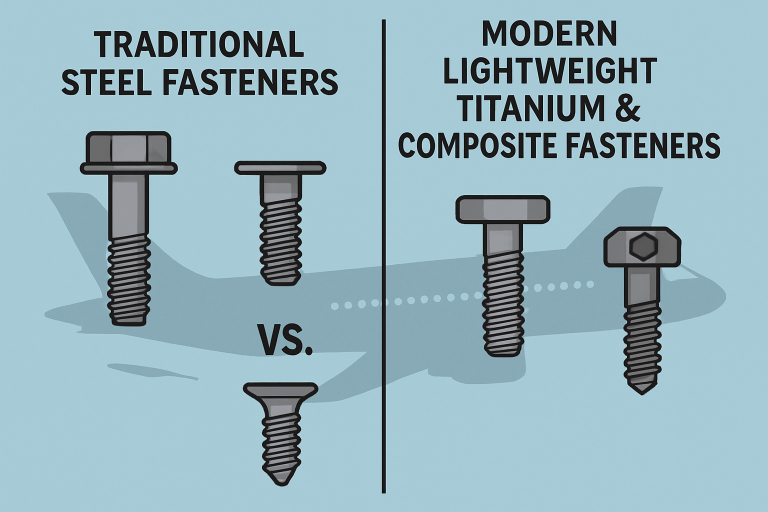
Historically, steel has dominated the production of aviation fasteners, but the industry has rapidly shifted toward lighter, more resilient alternatives. Titanium is now widely favored, boasting around 40% less weight than traditional steel fasteners and offering exceptional strength-to-weight performance. In addition to titanium, aluminum and high-tech composite polymers are making notable inroads, supported by ongoing improvements in mechanical properties and corrosion resistance.
By deploying fasteners constructed from these advanced materials, manufacturers achieve significant reductions in airframe weight while preserving, and often enhancing, structural performance. The aerospace industry’s embrace of these changes is clear in new aircraft designs from leading manufacturers and in the supply chain roadmaps of component specialists.
Advanced Manufacturing Techniques
The advent of additive manufacturing, also known as 3D printing, has profoundly impacted the design and production of aerospace fasteners. This technology enables the creation of custom shapes and intricate internal geometries that were previously unattainable with conventional processes, resulting in lighter components that meet rigorous aerospace certification standards. GE Aviation, for example, now produces engine components, such as fuel nozzles, using additive manufacturing, which reduces their weight by over a quarter and decreases assembly complexity by combining what would have been dozens of parts into one.
Innovative manufacturing methods, such as computer numerical control (CNC) machining and powder metallurgy, ensure tighter tolerances and optimized material use, further reducing part weight and enhancing reliability.
Structural Adhesives: A Complementary Approach
Alongside advanced fasteners, structural adhesives now play a central role in modern airframe assembly. Used in combination with mechanical fasteners, adhesives offer enhanced load distribution and bond a wider range of materials, opening up new design possibilities and additional weight reductions. The adoption of these technologies has accelerated on next-generation programs such as the Boeing 787 and Airbus A350, underscoring the industry’s interest in holistic lightweighting strategies.
By enabling more uniform stress distribution and allowing for fewer fasteners overall, structural adhesives help decrease overall aircraft weight, simplify assembly, and improve fatigue resistance—major wins in the quest for more efficient aviation.
Challenges and Considerations
Despite the promise and proven benefits of lightweighting, several hurdles persist. Advanced materials, such as titanium and high-grade polymers, often command a premium cost, making widespread adoption an economic consideration for manufacturers and airlines alike. Additional challenges arise in validating the fatigue resistance and predictability of these new materials and fastener designs, especially as they are subjected to rigorous FAA and EASA certification processes.
Careful integration with legacy airframe components is crucial, as is ongoing collaboration among engineering teams, supply chain partners, and regulatory authorities. Each innovation requires a detailed evaluation to ensure compliance, safety, and operational readiness before it joins the global fleet.
Final Thoughts
Innovations in fastener design, material science, and advanced manufacturing are critical enablers of aviation’s lightweighting revolution. These small but indispensable components deliver significant fuel savings, environmental benefits, and cost reductions for operators worldwide. As technology continues to evolve, the partnership between engineers, manufacturers, and hardware distributors will remain central to aviation’s progress toward more sustainable and efficient flight.

SDMS PX is an important digital platform used in the oil and gas distribution sector, especially by partners of Indian Oil Corporation Limited. It stands for Sales & Distribution Management System (SDMS) and is designed to simplify business operations for dealers, distributors, and commercial partners.
In today’s fast-moving digital world, manual processes are inefficient and error-prone. SDMS PX solves this problem by providing a centralized online system where users can manage orders, track stock, monitor payments, and generate reports—all in one place.
What is SDMS PX?
SDMS PX is a secure, login-based portal that allows authorized business partners to handle their daily petroleum and LPG operations digitally. It acts as a bridge between the company and its distribution network, improving communication and efficiency.
The platform is not available to the general public. Only approved dealers, LPG distributors, transport contractors, and institutional buyers can access it using credentials issued by Indian Oil.
Key Features of SDMS PX
1. Order Management
Users can place fuel or LPG orders directly through the system. It also allows tracking of order status in real time.
2. Stock Monitoring
The portal provides updated stock information, helping dealers avoid shortages or overstocking.
3. Invoice and Billing System
All financial records, including invoices and payment details, are available digitally, reducing paperwork.
4. Account Management
Dealers can view account balances, credit limits, and transaction history.
5. Reporting and Analytics
The system generates reports on sales, inventory, and performance, helping businesses make better decisions.
6. Secure Communication
The platform allows official communication between the company and dealers through notifications and alerts.
Who Can Use SDMS PX?
Access to SDMS PX is limited to:
Petrol pump dealers
LPG distributors
Industrial customers
Transport contractors
Institutional buyers
These users are registered through official procedures and receive login credentials after verification.
How SDMS PX Works
The working process is simple:
User logs into the portal using credentials
Dashboard displays all operational modules
User selects required function (order, billing, stock, etc.)
Data is processed and updated in real time
Reports and records are stored for future reference
This digital workflow replaces traditional manual systems, improving speed and accuracy.
Benefits of SDMS PX
1. Time Efficiency
Automates repetitive tasks, saving time.
2. Transparency
Provides clear visibility into orders, stock, and finances.
3. Accuracy
Reduces human errors in calculations and data entry.
4. Cost Reduction
Minimizes paperwork and operational costs.
5. Better Decision-Making
Real-time data helps businesses plan effectively.
Login and Registration Process
Registration
There is no public registration. The company registers dealers internally after approval.
Login Steps
Visit the official portal
Enter User ID and Password
Complete security verification (if required)
Access dashboard
Password Reset
Users can reset passwords using OTP or by contacting support.
Common Issues and Solutions
Problem
Solution
Incorrect password
Reset using OTP
Account locked
Contact support
Browser error
Clear cache or change browser
Slow loading
Check internet connection
Calculation Example (Practical Use Case)
SDMS PX helps dealers manage financial and inventory calculations. Let’s look at a simple example:
Example: Fuel Order Cost Calculation
If a dealer orders:
Quantity = 5,000 liters
Price per liter = 280 PKR
Formula
Total Cost = Quantity × Price per liter
Total Cost=Quantity×Price per liter
Calculation
Total Cost = 5000 × 280 = 1,400,000 PKR
This calculation helps dealers estimate expenses before placing orders.
Importance of SDMS PX in Digital Transformation
Before SDMS PX, dealers relied on manual paperwork, phone calls, and physical visits. This caused delays and errors. Now, with digital systems:
Processes are faster
Data is centralized
Communication is improved
Business becomes more scalable
SDMS PX plays a key role in modernizing the oil distribution ecosystem.
Security Features
Encrypted login system
OTP authentication
Secure data storage
Restricted access
Regular system updates
Users are advised not to share login credentials and always log out after use.
FAQs About SDMS PX
1. What is SDMS PX used for?
It is used to manage orders, stock, billing, and financial records for oil and LPG dealers.
2. Can anyone access SDMS PX?
No, only authorized business partners can access it.
3. How do I register on SDMS PX?
Registration is handled internally by the company after dealership approval.
4. What should I do if I forget my password?
Use the password reset option or contact support.
5. Is SDMS PX secure?
Yes, it uses encryption, authentication, and restricted access to ensure security.
6. Can I track my orders in real time?
Yes, the platform provides live tracking of orders and deliveries.
7. Does it help with financial management?
Yes, it shows invoices, account statements, and payment details.
Conclusion
SDMS PX is a powerful digital tool that simplifies the complex operations of fuel and LPG distribution. By combining order management, financial tracking, and reporting into one platform, it improves efficiency, transparency, and accuracy.
For businesses working with Indian Oil, SDMS PX is not just a portal—it is an essential system that supports daily operations and long-term growth. As digital transformation continues, platforms like SDMS PX will become even more important in ensuring smooth and efficient business management.
Belgium is a small yet highly influential country located in Western Europe. Despite its modest size, Belgium plays a major role in European politics, global trade, culture, and history. Known for its medieval cities, delicious chocolates, waffles, fries, and strong beer culture, Belgium offers a rich blend of tradition and modernity. It is also the political heart of Europe, hosting major international institutions such as the European Union and NATO.
Geography and Location
Belgium is bordered by France to the southwest, Germany to the east, Luxembourg to the southeast, and the Netherlands to the north. The country also has a coastline along the North Sea, which supports trade, fishing, and tourism.
Geographically, Belgium is divided into three main regions:
Coastal Plain – flat land near the North Sea
Central Plateau – fertile land used for agriculture
Ardennes – a hilly, forested region in the southeast
This geographic diversity supports farming, industry, and tourism.
History of Belgium
Belgium’s history is shaped by centuries of foreign rule. It was once part of the Roman Empire, followed by control from Spain, Austria, France, and the Netherlands. Belgium officially became an independent country in 1830 after separating from the Netherlands.
During both World War I and World War II, Belgium played a significant strategic role due to its central European location. Many famous battles were fought on Belgian soil, leaving a lasting impact on the nation’s identity.
Today, Belgium is a constitutional monarchy with a strong democratic system.
Government and Political Importance
Belgium is a federal constitutional monarchy. The King serves as the head of state, while the Prime Minister leads the government. The country is divided into regions and communities, each with its own authority.
Belgium is globally important because:
Brussels is the capital of the European Union
It hosts NATO headquarters
It is a center for international diplomacy
This makes Belgium one of the most politically influential countries in the world relative to its size.
Languages and Culture
Belgium is a multilingual country with three official languages:
Dutch (Flemish) – spoken in Flanders
French – spoken in Wallonia
German – spoken by a small community in the east
Belgian culture is a mix of Germanic and Latin influences. Art, music, literature, and architecture play an important role in daily life. Belgium is famous for painters such as René Magritte and Peter Paul Rubens.
Festivals, parades, and local traditions are celebrated throughout the year, reflecting the country’s deep cultural roots.
Belgian Cuisine
Belgian food is world-famous and deeply loved by locals and tourists alike. Some iconic Belgian foods include:
Belgian waffles
Belgian chocolate
French fries (Belgian fries)
Moules-frites (mussels and fries)
Belgium is also known for its beer culture, offering more than 1,500 varieties of beer, many brewed using traditional methods passed down for generations.
Economy of Belgium
Belgium has a highly developed, export-oriented economy. Its central location makes it a major hub for logistics and trade in Europe. The Port of Antwerp is one of the largest ports in the world.
Key economic sectors include:
Manufacturing
Pharmaceuticals
Chemicals
Services and finance
International trade
Belgium’s economy benefits from a skilled workforce, strong infrastructure, and political stability.
Education and Living Standards
Belgium has a high standard of living and a strong education system. Education is compulsory for children, and higher education institutions attract international students from across the globe.
Healthcare in Belgium is among the best in Europe, supported by a robust social security system. Citizens enjoy good work-life balance, public transport, and social welfare benefits.
Tourism in Belgium
Tourism is an important part of Belgium’s economy. Popular destinations include:
Brussels – known for the Grand Place and Atomium
Bruges – famous for canals and medieval architecture
In the digital realm, permissions serve as the fundamental gatekeepers controlling access to resources, data, and functionality. Whether you’re managing a multi-user operating system, a complex enterprise application, or cloud infrastructure, understanding permissions is crucial for both security and operational efficiency. This comprehensive guide explores permission models, calculation methods, and practical implementation strategies that form the backbone of modern access control systems.
What Are Permissions?
Permissions are rules that determine who can do what with a specific resource. They define the actions users, systems, or processes are authorized to perform on files, databases, applications, or network resources. At their core, permissions balance two competing priorities: enabling necessary access while preventing unauthorized actions.
Core Permission Models
1. Discretionary Access Control (DAC)
The most common model in consumer systems, DAC allows resource owners to control access. In Linux/Unix systems, this manifests as:
User (Owner) permissions: Rights for the file’s creator
Group permissions: Rights for members of a designated group
Others permissions: Rights for everyone else
2. Mandatory Access Control (MAC)
Used in high-security environments (government, military), MAC employs system-wide policies that users cannot override. Security labels (like “Top Secret,” “Confidential”) determine access based on clearance levels.
3. Role-Based Access Control (RBAC)
The enterprise standard, RBAC assigns permissions to roles rather than individual users. Users inherit permissions through role membership, simplifying management in large organizations.
4. Attribute-Based Access Control (ABAC)
The most granular model, ABAC evaluates multiple attributes (user department, time of day, resource sensitivity) to make dynamic access decisions.
Permission Calculations: The Mathematics of Access Control
Linux/Unix Permission Calculations
Unix-style permissions use a three-digit octal system representing read (r), write (w), and execute (x) permissions.
Binary to Octal Conversion:
text
Permission Binary Octal Meaning
--- 001 1 Execute only
--w- 010 2 Write only
-w- 010 2 Write only
-wx 011 3 Write & Execute
r-- 100 4 Read only
r-x 101 5 Read & Execute
rw- 110 6 Read & Write
rwx 111 7 Read, Write & Execute
Example Calculation: A file with permissions rwxr-xr-- translates to:
Owner: rwx = 4+2+1 = 7
Group: r-x = 4+0+1 = 5
Others: r– = 4+0+0 = 4
Final permission code: 754
Calculating Possible Permission Combinations
For a standard 3-tier system (user, group, others) with 3 permissions each (read, write, execute):
Total combinations = 2^9 = 512 possible permission sets
This accounts for each of the 9 permission bits being either on (1) or off (0).
RBAC Permission Complexity Calculation
In RBAC systems, the number of possible permission assignments grows exponentially:
text
Possible assignments = U × R × P
Where:
U = Number of users
R = Number of roles
P = Number of permissions
For a medium organization with 100 users, 20 roles, and 500 permissions: Possible assignments = 100 × 20 × 500 = 1,000,000 potential combinations
This illustrates why careful RBAC design is crucial—manual management becomes impossible at scale.
Best Practices for Permission Management
1. Principle of Least Privilege (PoLP)
Grant only the minimum permissions necessary for users to complete their tasks. This limits potential damage from errors or compromised accounts.
2. Regular Permission Audits
Schedule quarterly reviews of all permission assignments to identify and remove unnecessary access (permission creep).
3. Use Groups/Roles, Not Individual Assignments
Assign permissions to groups or roles rather than individual users, reducing management overhead.
4. Implement Permission Inheritance Wisely
Use inheritance to propagate permissions through directory structures, but override when specific exceptions are needed.
5. Log and Monitor Permission Changes
Maintain audit trails of all permission modifications for security investigations and compliance.
Common Permission Pitfalls and Solutions
Problem
Cause
Solution
Permission Denied Errors
Insufficient rights
Verify user/group membership and explicit denies
Too Much Access
Overly permissive settings
Apply principle of least privilege
Permission Creep
Accumulated rights over time
Regular access reviews
Broken Inheritance
Excessive overrides
Restructure hierarchy, use groups
Orphaned Accounts
Former employees retain access
Automated deprovisioning processes
Advanced Permission Concepts
Sticky Bits
Special permission that restricts file deletion in shared directories—only the file owner can delete their files.
Setuid/Setgid
Special execute permissions that allow programs to run with the privileges of the file owner (setuid) or group (setgid), used cautiously for security.
Access Control Lists (ACLs)
Extensions to standard permissions that allow more granular control with multiple users and groups per resource.
Implicit vs. Explicit Deny
Most systems use explicit deny overrides allow, where a specific denial takes precedence over any allowed permissions.
Permission Management Tools
Windows: icacls, PowerShell Get-Acl/Set-Acl
Linux: chmod, chown, getfacl, setfacl
Cloud Platforms: AWS IAM, Azure RBAC, Google Cloud IAM
Enterprise: SailPoint, Okta, Microsoft Identity Manager
FAQs:
Q1: What’s the difference between authentication and permissions?
Authentication verifies who you are (login process), while permissions determine what you can do after authentication.
Q2: Why do I get “Permission Denied” even when I own a file?
Check for:
Missing execute permission on parent directories
Filesystem mount options (like noexec)
SELinux/AppArmor restrictions
Conflicting group permissions
Q3: How do I calculate UNIX permissions quickly?
Use the octal method: Read=4, Write=2, Execute=1. Add values for each permission type. Example: Read+Write+Execute = 4+2+1 = 7
Q4: What’s the most secure permission setting for web directories?
Typical secure web directory permissions:
Files: 644 (rw-r–r–)
Directories: 755 (rwxr-xr-x)
Configuration files: 600 (rw——-)
NEVER use 777 (rwxrwxrwx) on production servers
Q5: How often should I review permissions?
Critical systems: Monthly
Regular business systems: Quarterly
Full organization audit: Annually
Plus immediate review after employee role changes
Q6: What’s permission inheritance?
When files/folders automatically inherit permissions from their parent container. This simplifies management but can cause unintended access if not designed carefully.
Q7: Can permissions affect system performance?
Yes, particularly:
Complex ACLs with many entries
Nested group memberships in Active Directory
Real-time ABAC policy evaluation Performance impact is usually minimal but should be monitored in large systems.
Q8: What are “breaking permission inheritance” and when should I use it?
Stopping automatic permission inheritance from parent objects. Use when:
A subfolder needs different security than its parent
Isolating sensitive data within a directory structure
But use sparingly—it increases management complexity
Future Trends in Permission Management
Zero Trust Architecture
Moving from “trust but verify” to “never trust, always verify,” with continuous permission validation.
Immutable distributed ledgers for permission change tracking.
Context-Aware Permissions
Dynamic permissions adapting to location, device security posture, time, and behavior patterns.
Calculation
Permissions represent the critical intersection of functionality and security in digital systems. From simple file permissions to complex enterprise RBAC implementations, understanding permission models and calculations enables effective access control that protects assets while enabling productivity. As systems grow more complex, the principles of least privilege, regular auditing, and systematic management become increasingly vital.